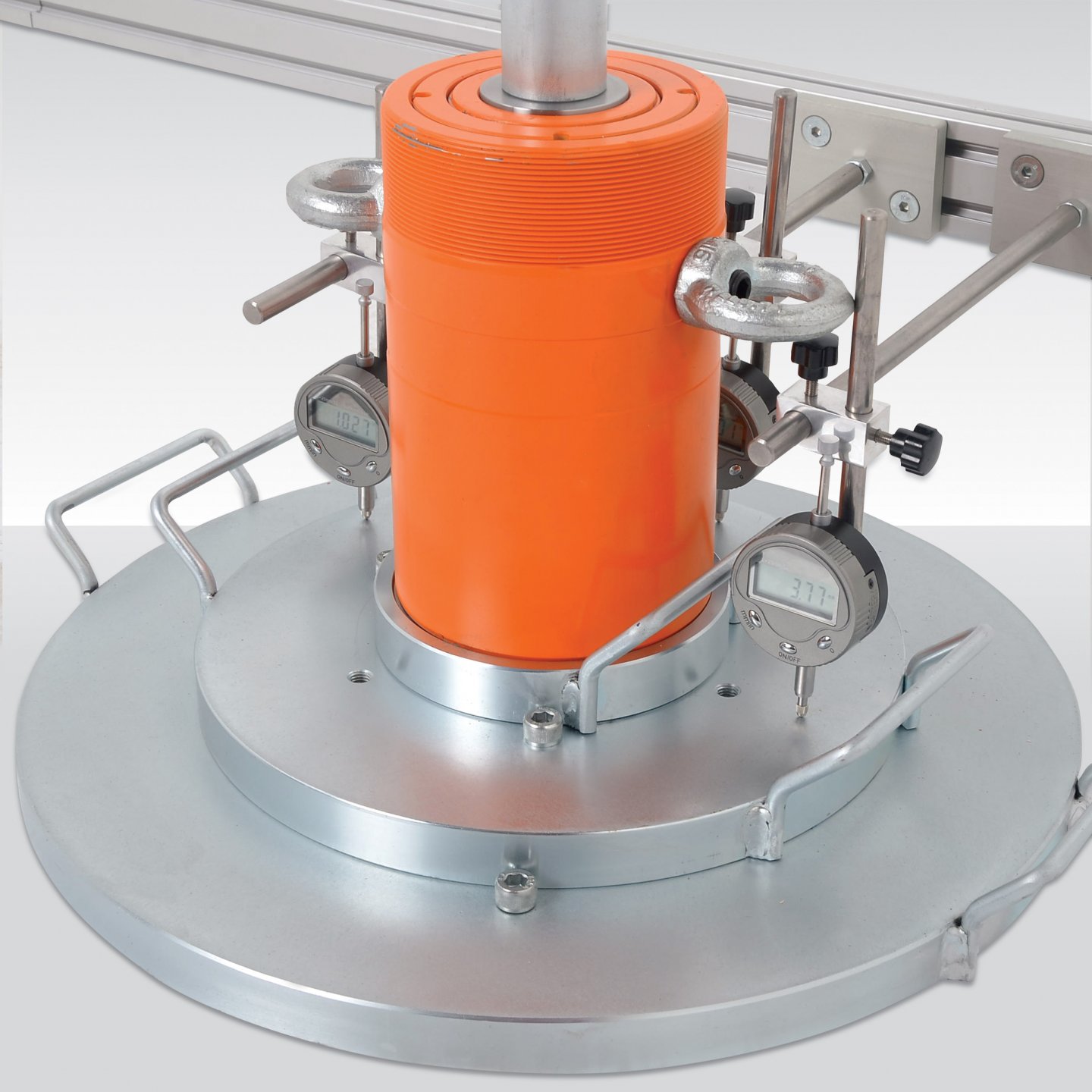
Plate load testing devices are used to determine the load on ground to introduced settlement, a measure of ground's bearing capacity.

The Water Level Indicators (Electric Contact Meters) are easily transported, user-friendly and reliable instruments used for measuring water level and total depth in boreholes, wells, observation pipes, reservoirs. They are also used to control pumping tests.

The UTS Series of Pocket Dial Penetrometers are perfect tools to determine the penetration resistance of cohesive soil, especially when various range measurements are required.

The Field Inspection Testing Kit may be purchase with a Pocket Penetrometer and/or a Pocket Vane Tester.

The UTS-0024 Hand Boring and Sampling Set is used for augering down to a depth of 5 meters.

Laarmann Test sieves are produced to comply with the specifications set out by the world's most demanding Standards.

The UTS-2060.SMPR Automatic Direct / Residual Shear Test Machine is motorized and floor mounted, its test range covers the determination of consolidated drained shear strength of a soil material by direct shear.

A Sand Replacement Test Set is used to measure the degree of compaction on site.

The consolidation attributes of soils of low permeability can be determined with a One-dimensional Consolidation test. UTest's Oedometer is suitable to complete such a test.

The Sand Equivalent Shaker is used for the uniform shaking of Sand Equivalent Measuring Cylinders, at a specified rate and stroke.

The Sand Equivalent test set is used to determine empirically the fines content and type in samples of aggregates.

Whether for use in simple drying processes, ageing, curing or general investigations, Scientific ovens provide the ideal solution for diverse thermal applications.

Designed in response to feedback from labs Australia and NZ wide, our mould is the new winner for performance and cost. Accessories are available including collars, surcharges and base plates.

The California Bearing Ratio (CBR) test is a measure of the strength of subgrade soil and highway sub base and subgrade via a penetration test. It is designed for testing cohesive materials with a particle size less than 19mm, in Australia the governing standard is AS 1289.6.1.1. An automatic or multiplex machine is also available.

The California Bearing Ratio (CBR) test is a measure of the strength of subgrade soil and highway sub base and subgrade via a penetration test. It is designed for testing cohesive materials with a particle size less than 19mm, in Australia the governing standard is AS 1289.6.1. A manual or multiplex machine is also available.

The UTG-0130 10 litre capacity Laboratory Mixer is designed for mixing of soil and asphalt samples to be used for mechanical tests such as compaction, indirect tensile, Marshall etc.

The Cone Penetrometer is used to determine the moisture content at which clay soils pass from a plastic to a liquid state and used also for the determination of undrained shear strength.

The plastic limit (PL) is the term used for the lowest moisture content of a soil that will allow a sample to be rolled into threads of 3 mm diameter without the threads breaking.

This test method is used to measure the shrinkage ratio, volumetric shrinkage, shrinkage limit and linear shrinkage.

The UTEST Manual Liquid Limit Apparatus (Casagrande) is an apparatus used to measure the moisture content at which clay soils pass from plastic to liquid state.

The UTS-0235, Linear Shrinkage Mould is 140 mm long and has a radius of 12.5mm. It is used to determine the total linear shrinkage of soils and indicates the plastic properties of soils with low clay content.

Automatic Soil Compactor are designed to compact specimens automatically and uniformly, assuring conformity with Australian standards.

Moulds and rammers are used for determining the relationship between the moisture content and density of compacted soil.

Moulds and rammers are used for determining the relationship between the moisture content and density of compacted soil.

A range of industrial balances available for CMT Lab Testing Requirements.

A Multiplex Machine is used to perform UCS [Uniaxial], Triaxial, CBR and Marshall Tests. The apparatus is capable of doing tests with the speed range of 0.00001 mm/min to 51 mm/min. The base machine designed with a sturdy and compact two column frame, with an adjustable upper cross beam. Additional accessories are required to suit the desired test methods, listed below.

Soil Testing Equipment

PCTE provides high-quality soil testing equipment designed for contractors, consultants and lab owners across Australia and New Zealand. Our soil density testing equipment and soil testing machines are built to deliver precise and reliable results, ensuring the success of your testing programs. From measuring moisture content to assessing soil compaction, PCTE’s range of tools is perfect for a variety of applications in the construction and engineering industries.

Why PCTE is Your Best Option for Soil Testing Equipment

With over two decades of industry experience, PCTE offers soil testing equipment that is reliable, accurate, and designed to meet the rigorous demands of professional testing environments. Our equipment helps contractors and consultants ensure that soil conditions are optimal for construction projects.

  • Advanced Testing Tools: Our soil testing machines are designed for a wide range of applications, from soil compaction to moisture content analysis.
  • Accurate and Reliable Results: PCTE’s soil density testing equipment ensures high accuracy, helping you meet compliance and safety standards.
  • Comprehensive Product Range: From field inspection kits to advanced laboratory tools, we offer a wide variety of soil testing equipment for any project.
  • Durable and Long-Lasting: Our equipment is designed to handle tough testing environments, offering long-term reliability.
  • Expert Support: PCTE provides full technical support for all our soil testing machines, ensuring optimal use and accurate results.

Soil Testing Equipment: Why Choose It for Your Project?

At PCTE, we understand the importance of having the right tools for soil testing. Our soil testing equipment is specifically designed for professionals who need to ensure the safety and reliability of construction projects. Tools like GPR systems enable non-destructive testing, ensuring the integrity of the soil is analysed without causing damage.

For measuring soil density, we offer soil density testing equipment that accurately assesses compaction, moisture content and the suitability of soil for construction. Our soil testing machines are built for efficiency and precision, delivering results you can trust.

By choosing PCTE’s soil testing equipment, you gain access to high-quality tools designed to make your testing processes easier, faster, and more accurate.

Explore More

Whether you're looking for advanced tools, software or non-destructive testing options, we have everything you need to ensure your testing processes are thorough and accurate.

  • Construction Testing Instruments & Tools: We offer a wide array of essential tools designed for testing the physical properties of construction materials, ensuring they meet industry standards for safety and durability.
  • Software Solutions: Our cutting-edge software supports data analysis, test result documentation, and efficient report generation, streamlining your testing processes and improving productivity.
  • Non-Destructive Testing (NDT): PCTE’s NDT solutions, including GPR equipment, enable detailed evaluations of materials without causing damage, making them ideal for assessing structural integrity and underground conditions.
  • GPR Equipment: Ground Penetrating Radar (GPR) systems for subsurface analysis and mapping, enabling you to detect structural elements or hidden issues without disturbing the material.

Each product is engineered to meet the rigorous demands of construction and engineering professionals, delivering high accuracy and reliability every time.

Warranty & Returns

PCTE offers a manufacturer’s warranty on all soil testing equipment sold. Returns are accepted within 7 days if the equipment is unused and in its original condition. Some specialised equipment, such as customised soil testing machines or sealed products, may not be returnable unless defective. For further details, please refer to our Warranty & Returns Policy.

Shipping & Delivery

PCTE ensures the timely and reliable delivery of soil testing equipment across Australia and New Zealand. Delivery times are estimates, and we make every effort to deliver your items promptly. If delivery is refused or there are delays, a restocking fee of up to 25% may apply. For more information, refer to our Shipping & Delivery Policy or reach out through the Contact Us page.

FAQs

Which method is best for large-scale soil testing projects?
For large-scale projects, density test systems and soil compaction testing are crucial for evaluating soil strength and stability. GPR systems can also be useful for quick, non-invasive analysis of large areas. PCTE’s advanced soil testing machines are perfect for handling large volumes of data with high accuracy and reliability.
How does moisture affect soil density readings?
Moisture content significantly affects soil density. High moisture levels can make the soil more compact, while dry soil may appear more porous. PCTE soil density testing equipment ensures moisture content is properly measured, providing accurate density readings. By evaluating moisture levels, you can determine the soil’s suitability for construction and ensure optimal compaction.
What types of soil testing machines does PCTE offer?
PCTE offers a wide range of soil testing machines, including density test systems, field inspection kits, pocket penetrometers, and compaction testers. Our equipment is designed for a variety of tests, including compaction, moisture content, and penetration resistance. We also offer GPR systems for non-destructive soil testing, ideal for quickly and safely mapping and evaluating soil conditions.
How do I maintain my soil testing equipment?
Regular maintenance is key to ensuring the longevity and accuracy of your soil testing equipment. Clean all tools after use, especially soil density testing equipment and soil testing machines, to prevent the buildup of dirt and debris. Periodically inspect equipment for signs of wear and tear, and recalibrate instruments as needed. Always store your equipment in a dry, cool place to prevent damage.
Can I use PCTE’s soil testing equipment for both field and laboratory tests?
Yes, PCTE’s soil testing range includes both field testing devices and lab testing devices. Equipment like LWD’s and Plate Load testing are rugged and great for the field. The majority of the range is for the laboratory where we provide gear to fulfil most Australian and international standards. We can also help you scope the correct device for your application.
What should I do if my soil testing equipment is faulty or damaged?
If your soil testing equipment is faulty or damaged, contact PCTE immediately for troubleshooting, repairs or replacement. For products under warranty, we offer free exchanges or repairs. If the equipment is no longer under warranty, our team will guide you through the repair or replacement process. Please follow our Warranty & Returns Policy for more details.